


A research team led by Professor Sun Jun from our university has published a paper in The ISME Journal
A research team led by Professor Sun Jun from our university has published a paper in The ISME Journal, revealing for the first time that urea-driven nitrification in oligotrophic waters is a significant source of the greenhouse gas N2O
Recently, a research team led by Professor Sun Jun from the School of Oceanography and Environmental Sciences at our university has made significant progress in the study of oligotrophic open-ocean ecosystems. Their findings, titled “Urea-driven nitrification contributes to N2O production in the oligotrophic euphotic ocean,” were published in the top-tier international journal The ISME Journal. Professor Sun Jun served as the corresponding author of the paper, with doctoral student Gu Ting as the first author. Collaborators included postdoctoral researcher Chen Zhuo from the team and Professor David Hutchins from the University of Southern California.
This study is the first to systematically reveal the critical role of urea in the marine nitrogen cycle and the production of the greenhouse gas N2O, and it elucidates the mechanisms underlying its response to ocean acidification. It holds significant scientific value for accurately predicting the marine nitrogen cycle and greenhouse gas budgets in the context of global change.
In oligotrophic waters, how ammonia-oxidizing archaea (AOA) maintain nitrification in environments with extremely low ammonium levels has long remained a mystery. To address this scientific question, Professor Sun Jun’s team conducted a systematic study in the western tropical Pacific. Using techniques such as 15N isotope-labeled cultivation, N2O isotope source apportionment, metagenomic sequencing, and quantitative PCR, the research team quantitatively demonstrated the key role of urea metabolism in AOA as an alternative nitrogen source.
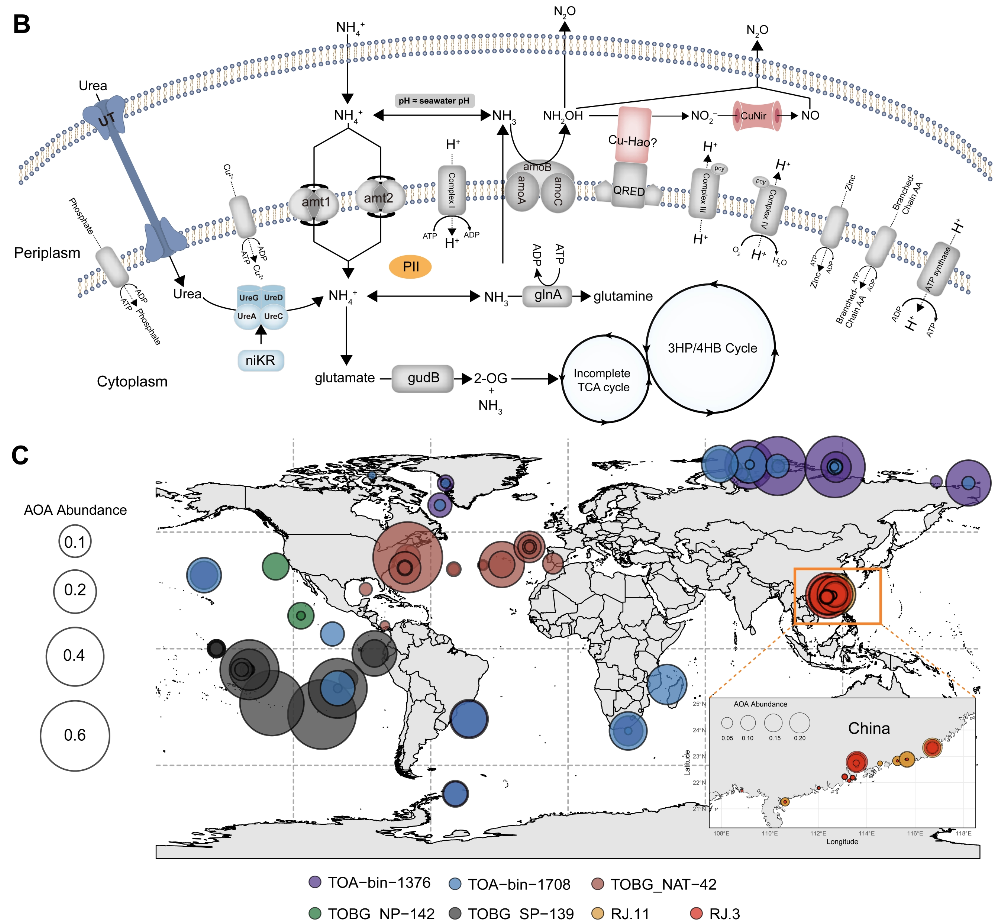
Metabolic Mechanisms and Global Distribution of Urea-Utilizing Ammonia-Oxidizing Archaea
This study yielded a series of important findings: N2O from phototrophic microorganisms primarily originates from AOA-mediated nitrification; urea-driven nitrification contributes a significant proportion of nitrogen transformation and N2O production, representing an important source of recycled nitrogen and N2O that had previously been underestimated; under ocean acidification conditions, the nitrification rate and N2O yield of the urea oxidation pathway are significantly enhanced; “Urea-type AOA” are widely distributed in the global ocean, demonstrating that the utilization of urea is a common and important ecological adaptation strategy for AOA in oligotrophic environments.
This study challenges conventional understanding of nitrogen cycle dynamics in oligotrophic seas and, for the first time, quantitatively elucidates the contribution of the urea oxidation pathway to greenhouse gas emissions. The findings indicate that future Earth system models must incorporate this pathway and account for its differential response to ocean acidification in order to improve the accuracy of predictions regarding the marine nitrogen cycle and greenhouse gas fluxes.
Publication details: Gu, T., Chen, Z., Hutchins, D. A., Sun, J. (2025). Urea-driven nitrification contributes to N₂O production in the oligotrophic euphotic ocean. The ISME Journal, wraf281.