


Education-themed case study and municipal-level graduate education reform project have gotten off to a great start!
Recently, the results of the 2025 Ministry of Education Degree Center Thematic Case Projects and the Tianjin Municipal Postgraduate Education Teaching Reform Projects were announced. Our university was approved for a total of 5 Ministry of Education thematic cases and 14 municipal-level teaching reform projects (including 4 key projects). With this total number of approved projects ranking among the top in Tianjin’s higher education institutions, we have achieved a strong start to the new semester’s postgraduate education efforts.
Cultivating the fertile ground of practical experience and strengthening the foundation of education through exemplary cases
In the Ministry of Education’s Degree Center’s 2025 thematic case study initiative, five case studies recommended by our university stood out among more than 2,200 applications nationwide. Our university ranked first among Tianjin’s higher education institutions in the number of approved projects, covering three core themes: “Modern Industrial System,” “AI+,” and “Going Global.” This fully demonstrates our university’s deep-rooted commitment to practice-oriented education and service to national strategies.
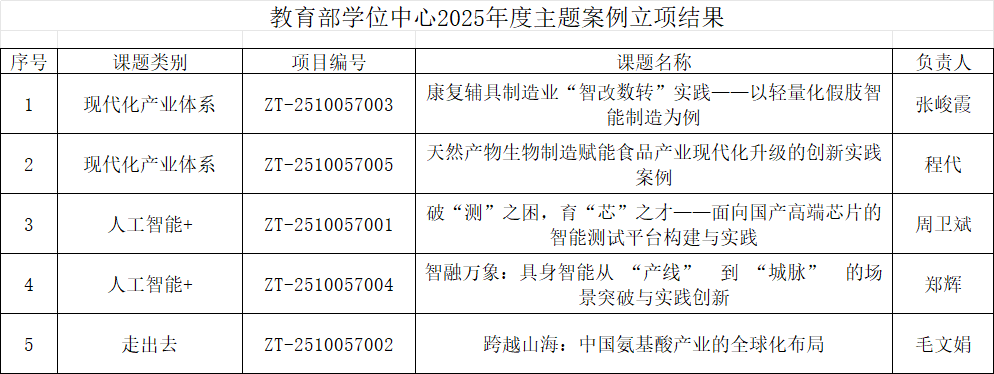
The selected case studies are all the result of long-term field research conducted by teams of faculty and students at the forefront of the industry, combining theoretical depth with practical value: *“Practices in Intelligent Transformation and Digital Transition in the Rehabilitation Assistive Devices Manufacturing Industry: A Case Study of Smart Manufacturing for Lightweight Prosthetics”* focuses on the development of a modern industrial system, specifically examining intelligent transformation and digital transition in the rehabilitation assistive devices manufacturing sector. Using the smart manufacturing of lightweight prosthetics as a case study, it explores the transition from traditional manufacturing to high-end intelligent manufacturing; “Innovative Practice Cases of Natural Product Biomanufacturing Empowering the Modernization and Upgrading of the Food Industry” addresses the need for integrated development between the biopharmaceutical and food industries, transforming real-world scenarios of core technology breakthroughs into educational resources; “Overcoming Testing Challenges and Cultivating Chip Talent: Construction and Practice of an Intelligent Testing Platform for Domestic High-End Chips” targets the pain points in talent cultivation within “chokepoint” technology fields, providing a new paradigm for practical teaching in the electronics and information sector; *Intelligent Integration of All Things: Scenario Breakthroughs and Practical Innovations in Embodied Intelligence from “Production Lines” to “Urban Vessels”* deeply integrates with Tianjin’s smart manufacturing development strategy, showcasing vivid pathways for artificial intelligence technology to serve industrial upgrading and urban development; *Crossing Mountains and Seas: The Global Expansion of China’s Amino Acid Industry* traces the complete journey of domestic enterprises going global, providing a vivid model for effectively telling the stories of Chinese enterprises.
Focusing on Key Areas: Driving Educational Reform to Strengthen the Engine of Student Development
The 14 projects approved under the Tianjin Municipal Higher Education Graduate Education Reform Research Program—comprising four key projects and ten general projects—mark a significant step forward for our university in advancing graduate education reform and enhancing the quality of graduate training, as we remain committed to the goal of building a leading nation in education.
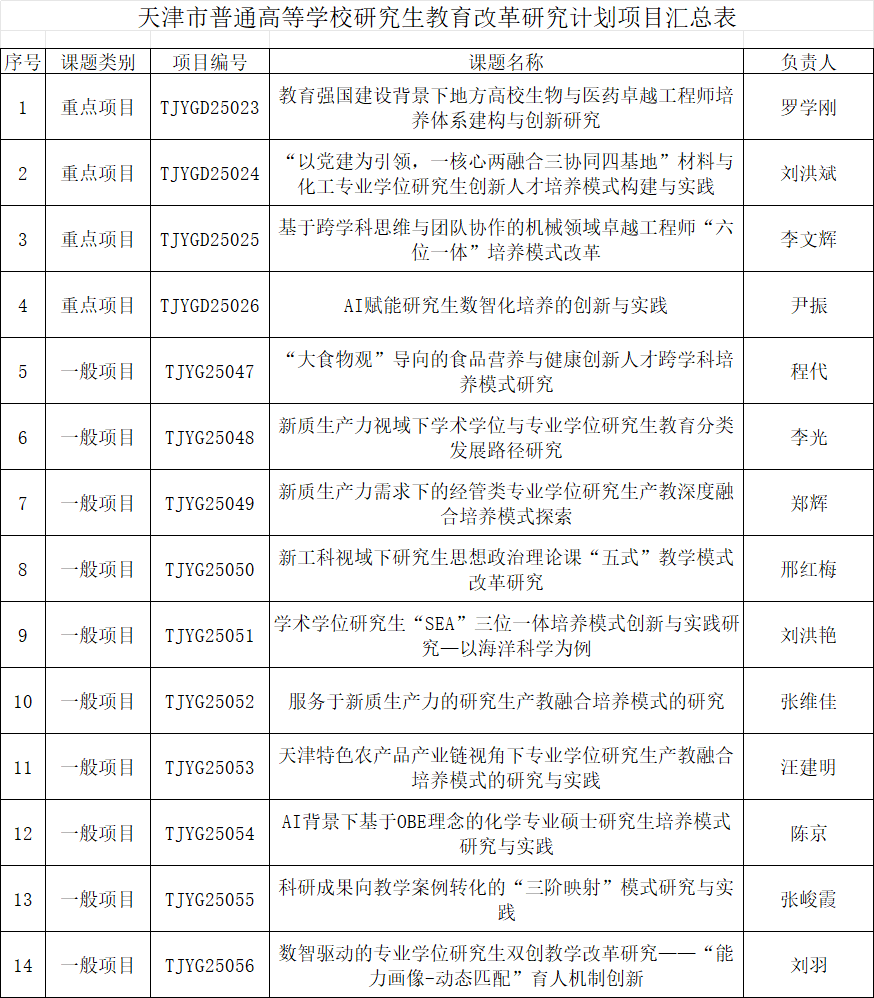
The approved research projects will consistently adhere to the strategic orientation of the “Four Orientations,” closely aligning with national demands for high-level scientific and technological self-reliance, Tianjin’s “1+3+4” modern industrial system layout, and the core tasks of the university’s “Pioneer Plan.” They will establish a three-dimensional research framework comprising “strategic frontier research, services tailored to local characteristics, and comprehensive coverage of the entire talent development chain”: Key projects will focus on core issues in higher education reform, such as the cultivation of outstanding engineers, interdisciplinary education, Party-building-led ideological and political education, and the digital and intelligent transformation of education. They will target pain points and bottlenecks in the graduate student training system to conduct systematic research, fully leveraging their role as “pioneers” of reform; General projects cover the entire educational process, including the differentiated training of academic and professional degree students, innovation in industry-education integration mechanisms, curriculum upgrades, and reforms in innovation and entrepreneurship education. These projects encompass both cutting-edge explorations in postgraduate education development under the context of new-quality productive forces and practical research serving the development of local industries in Tianjin, such as distinctive agriculture and high-end manufacturing, thereby generating reform momentum characterized by “key breakthroughs driving overall improvement.”
Building on our momentum, we will join forces to forge a new path forward
During the 14th Five-Year Plan period, our university implemented a series of initiatives, including reforms to postgraduate education innovation projects and the training model for professional degree students. We secured a total of 16 thematic case study projects approved by the Degree Center of the Ministry of Education, had 26 cases included in the “China Professional Degree Case Center Database,” and obtained over 60 provincial and ministerial-level educational reform projects, thereby laying a solid foundation for the high-quality, substantive development of postgraduate education.
These dual breakthroughs represent a milestone achievement resulting from the university’s implementation of the “3510” Strategic Project under the guidance of the “Pioneer Plan” and the comprehensive advancement of the “Excellence in Research and Teaching” Action Plan. They also serve as a concentrated manifestation of the ongoing deepening of graduate education reform. Taking this as a new starting point, the university will focus on the transformation of research outcomes and quality enhancement. Centered on the “3510” Strategic Project, it will establish a full-chain mechanism encompassing “funding support—process supervision—outcome incubation” to ensure that outstanding teaching reform proposals are prioritized for inclusion in training reforms and that all selected cases are fully integrated into professional degree curricula, thereby forming a virtuous cycle of “project initiation—research—application—dissemination.” At the same time, through measures such as strengthening full-cycle project management and linking project outcomes to performance evaluations, the university will continue to motivate faculty to actively engage in educational reform, effectively translating theoretical exploration into tangible educational outcomes, and providing a solid foundation for building a high-level, distinctive graduate education system.