


Professor Yin Huanshun’s Team from Our Institute Publishes a High-Impact Academic Paper
Recently, a research team led by Professor Yin Huanshun from our institute published an academic paper titled “Synergistic application of PEC-OPECT-CL multimodal biosensing and photocatalytic sterilization based on hollow tubular Bi12O17Cl2/In2O3 Z-scheme heterojunction for Vibrio parahaemolyticus” in Journal of Hazardous Materials, an international journal in the field of environmental science and ecology.
Vibrio parahaemolyticus, a major pathogen causing foodborne illnesses in seafood, poses a serious threat to human health. Although traditional detection methods—such as culture and isolation, immunological assays, and serological techniques—offer high sensitivity and specificity, they are limited by cumbersome procedures, time-consuming processes, and reliance on specialized personnel, making it difficult to meet the practical demand for rapid detection. Organic optoelectrochemical transistor (OPECT) biosensors, with their superior physical structure and signal amplification capabilities, can effectively address this challenge. However, single-mode detection still carries a risk of false positives, making it urgent to develop multi-mode collaborative detection strategies. Furthermore, existing research has primarily focused on the detection phase, with insufficient attention paid to the effective disinfection of bacteria after detection, which can easily lead to the risk of secondary contamination. Therefore, the development of an integrated platform that combines highly sensitive detection with efficient disinfection is of great significance for improving the closed-loop “monitoring-control” system for foodborne pathogens.
Based on this, the study focused on Vibrio parahaemolyticus to develop a dual-function synergistic platform that integrates detection and disinfection. By fabricating Bi12O17Cl2/In2O3 hollow tubular composites with a Z-type heterostructure, and combining isothermal nucleic acid amplification technology with a CdS QDs signal amplification unit, the researchers successfully developed a novel biosensing system based on a triple-mode PEC-OPECT-CL approach. This system not only achieves ultra-sensitive detection of Vibrio parahaemolyticus (with a detection limit as low as 1.13 CFU/mL in OPECT mode and 14.15 CFU/mL in CL mode) but also introduces CdS QDs as a colorimetric signal quencher into the TMB colorimetric system for the first time, thereby enhancing the accuracy and stability of the detection. Furthermore, under visible light irradiation, this material efficiently generates reactive oxygen species, achieving complete photocatalytic inactivation of high-concentration Vibrio parahaemolyticus (107 CFU/mL). The integrated detection-disinfection strategy established in this study significantly enhances disinfection efficiency while enabling precise pathogen identification, and the related technology demonstrates broad prospects in application scenarios such as food safety and water purification.
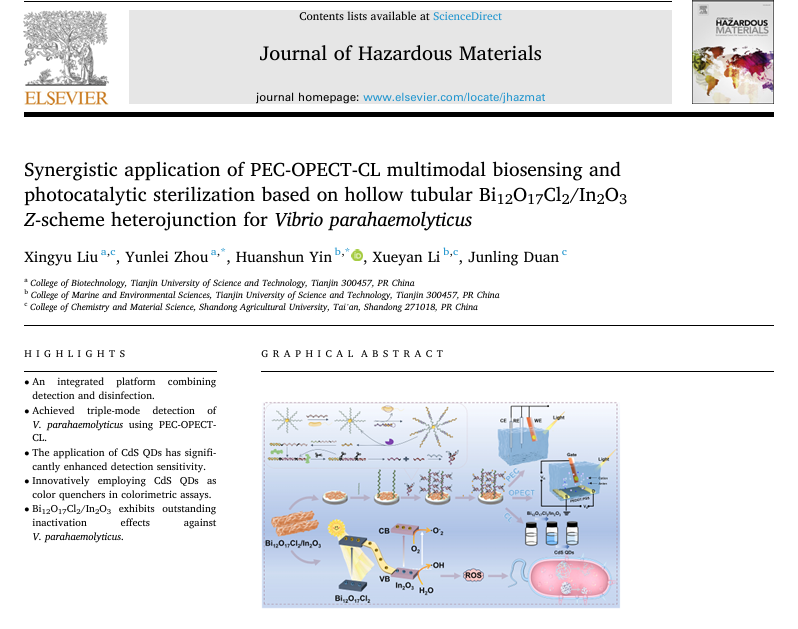
Journal of Hazardous Materials is a globally renowned, authoritative international journal in the fields of environmental science and ecology, focusing on research into the environmental behavior, impacts, control, and remediation technologies of hazardous substances (environmental pollutants). It is a top-tier journal in Zone 1 of the Chinese Academy of Sciences (CAS) ranking system, with a current impact factor of 11.3.
Yin Huanshun, Ph.D., Professor, and Ph.D. advisor, specializes in research on the electroanalytical monitoring and photocatalytic treatment of environmental pollutants. He has published over 200 SCI-indexed journal articles as first or corresponding author, with 8,412 SCI citations and an h-index of 54, including a total of 8 ESI highly cited papers. He has led four projects funded by the National Natural Science Foundation of China, two projects funded by the National Postdoctoral Fund, and four projects funded by the Shandong Provincial Fund. He holds 16 authorized national invention patents. His awards include one Third Prize in the Shandong Provincial Natural Science Award (second author), one First Prize in the Natural Science Award of the Shandong Society of Chemistry and Chemical Engineering (second author), three Second Prizes in the Natural Science Award of Shandong Higher Education Institutions (first author), one Third Prize (first author), and one Tai’an Youth Science and Technology Award. From 2020 to 2025, he was consecutively listed among the top 2% of scientists globally.