


High-Quality Development of Resource and Environmental Sciences
Forum on High-Quality Development of Resource and Environmental Sciences Empowered by New-Quality Productive Forces and the 2025 Global Reed and Bamboo Carbon-Neutral Industry Development Summit Held at Tianjin University of Science and Technology
To thoroughly study and implement the spirit of the 20th National Congress of the Communist Party of China and the Fourth Plenary Session of the 20th CPC Central Committee, and to further strengthen the development of our university’s resource and environmental disciplines, our university recently hosted the “Forum on New-Quality Productive Forces Empowering the High-Quality Development of Resource and Environmental Disciplines and the 2025 Global Reed Carbon Net-Zero Industry Development Summit” at the Binhai Campus. Academician Liu Wenqing, Chief Scientist at the Anhui Institute of Optics and Mechanics of the Chinese Academy of Sciences; Academician Jiao Nianzhi of Xiamen University; Lu Fuping, Deputy Party Secretary and President of Tianjin University of Science and Technology; Chen Guanyi, Deputy Party Secretary and President of Tianjin University of Commerce; Li Baochun, Secretary of the Tianjin Association for Sustainable Development; and Lu Shuangying, former member of the Party Leadership Group and Vice Chairman of the Tianjin Association for Science and Technology, attended the opening ceremony. More than 80 experts, scholars, and entrepreneurs from both within and outside the university participated in the event.
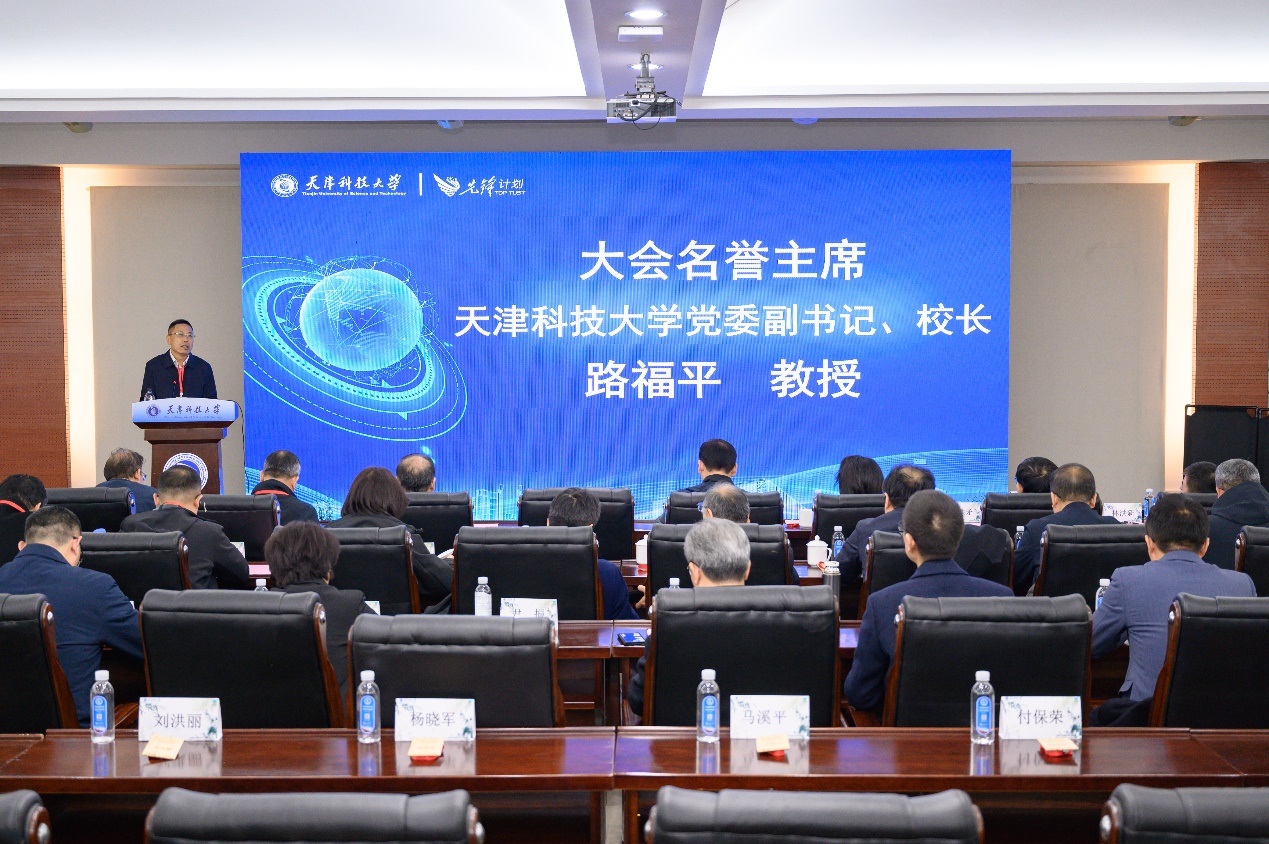
In his opening remarks, Lu Fuping, on behalf of the university, extended a warm welcome to the academicians, experts, scholars, and corporate representatives in attendance. He outlined four key priorities for the discipline’s development: First, we must deepen theoretical exploration, thoroughly examine the core essence and implementation pathways of “new-quality productive forces,” and explore new models for the high-quality development of the resource and environmental discipline to provide strategic guidance for its advancement. Second, we must continue to deepen industry-university-research collaboration, establish a collaborative innovation platform involving government, industry, academia, research, and application, promote the commercialization of scientific and technological innovations, and build a complete industrial chain. Third, we must focus on cultivating high-level innovative talent; through high-level academic exchanges and the collision of ideas, we will nurture more high-quality professionals in the field of resources and the environment who possess an innovative spirit and practical capabilities. Fourth, we must enhance the discipline’s influence and social visibility, pool high-quality resources, and help the discipline achieve high-quality, substantive development.
In her remarks, Li Baochun noted that as a major national industrial city and the economic hub of northern China, Tianjin has achieved remarkable results in promoting green and low-carbon development and steadily advancing the implementation of the “dual carbon” strategy. This forum, which focuses on the development of resource and environmental disciplines and the practical application of carbon-neutral industries, combines strategic vision with practical value, providing crucial governance support for Tianjin’s efforts to advance green and low-carbon development and foster new productive forces.
In his opening remarks, Chen Guanyi stated that this forum is not only a high-level academic gathering but also a practical initiative to promote the deep integration of scientific and technological innovation with industrial development. The “dual carbon” goals chart the course for green and low-carbon transformation, while new-quality productive forces inject strong momentum into high-quality development. The core of this lies in innovation, the key lies in green transformation, and the ultimate goal lies in industrial upgrading. The resource and environment sector is precisely the key area for fostering new-quality productive forces and practicing green development. He expressed hope that this forum would deepen exchanges, build consensus, and contribute wisdom and strength to the high-quality development of resource and environment disciplines as well as the innovation and upgrading of Luzhu’s carbon-neutral industries.
Liu Wenqing delivered a presentation titled “AI-Empowered Innovation in Atmospheric Environmental Sensing Technology,” sharing insights on topics such as AI-enabled environmental monitoring and carbon neutrality, and charting a clear path for the development of resource and environmental sciences. Jiao Nianzhi delivered a keynote speech titled “International Standards for Ocean Negative Emissions and Carbon Neutrality” via video conference. He called on researchers to join hands in building a cooperative and mutually beneficial global climate governance system, contributing to the creation of a beautiful and sustainable Earth.
Professor Song Youtao, academic leader of the Resources and Environment discipline at Tianjin University of Science and Technology and Dean of the School of Economics and Management, delivered a report titled “Development Report on the Resources and Environment Discipline at Tianjin University of Science and Technology.” The report provided a systematic overview of the discipline’s development history, current status, and future plans. Attending experts and scholars engaged in in-depth discussions on the development of the Resources and Environment discipline at Tianjin University of Science and Technology, offering suggestions on aspects such as disciplinary characteristics, platform development, and talent cultivation, thereby injecting intellectual momentum into the discipline’s high-quality development.
The forum also released the *Global Carbon-Neutral Bamboo Industry White Paper (2025)*.
This forum further clarified the development direction of our university’s resource and environmental disciplines, providing crucial support for advancing the distinctive development of these disciplines and enhancing the quality of high-level talent cultivation.